AI Contract Review: Audit Ready Results and a Buyer's Checklist
AI Contract Review: Audit Ready Results and a Buyer's Checklist
AI contract review automates clause extraction, flags high-risk provisions, and drafts suggested redlines, so legal teams review contracts faster and more consistently than manual passes allow. The technology works best on high-volume, repeatable contract types, and it still requires a qualified reviewer to confirm findings before they become decisions. If you're evaluating a platform, run a pilot on real contracts before committing to a license.
TL;DR:
Platforms with dedicated legal extraction models outperform general-purpose LLMs in recall for critical contract clauses, reducing missed high-risk provisions.
Most effective AI tools provide clause-specific citations and batch review capabilities, enabling accurate and scalable contract analysis across entire portfolios.
Vendor transparency on architecture, accuracy rates, security certifications, and human-in-the-loop workflows is crucial to ensure trustworthy and compliant use.
In-house legal teams should pilot AI on routine, low-risk contracts to establish error rates and build trust before addressing high-stakes deals.
A thorough vendor evaluation involves verifying evidence trails, testing real contracts, and ensuring the platform supports integration, customization, and transparent reporting.
What AI Contract Review Platforms Actually Deliver
Ask any vendor what their platform produces, and you'll get a features list. What you actually need to know is what lands on your desk after the software finishes a pass. That output determines whether the tool saves you real time or just adds another dashboard to check.
A properly configured system extracts the structural backbone of a contract: parties, dates, renewal terms, and obligations, organized so nothing gets missed on a skim read. It flags risk with severity labels rather than a flat list of concerns, so a reviewer knows what needs attention today versus what can wait. Most platforms also generate a redline overlay, showing suggested edits directly against your existing playbook language.
The output typically includes:
Clause-level extraction covering parties, dates, obligations, and renewal triggers
Risk findings tagged by severity, with the source clause and page cited as evidence
Tracked-change redlines exportable to your standard editor
Plain-language summaries built for reviewers who don't have time to read the full document
Portfolio-level analytics across dozens or hundreds of agreements, exportable to Excel, Word, or PDF
That last point matters more than it sounds. A single contract review is useful. A portfolio view across your entire agreement base, showing which vendor contracts share the same risky indemnification language, is what actually changes how legal operations functions.
How AI Contract Review Works: The Technology Explained
Most platforms marketed as AI contract review software combine four distinct technologies, and understanding the split matters because it explains where accuracy comes from and where it breaks down.
Optical character recognition (OCR) converts scanned or image-based PDFs into machine-readable text. Without it, a platform can't process an older contract that only exists as a scanned signature page. Natural language processing (NLP) then identifies clause types, structure, and boundaries within that text. It's the layer that recognizes an indemnification clause as an indemnification clause, regardless of how a specific drafter phrased it.
The more consequential distinction is between purpose-trained extraction models and general-purpose language models. Purpose-built legal extraction models, trained on large contract corpora, deliver higher recall on critical clauses than a general LLM operating alone, according to a Cambridge Judge Business School study on specialized AI models. The recommended architecture pairs a dedicated extraction model with a generative layer for summaries and redline drafting, an approach the same research flags as preferable whenever missing a clause carries real risk.
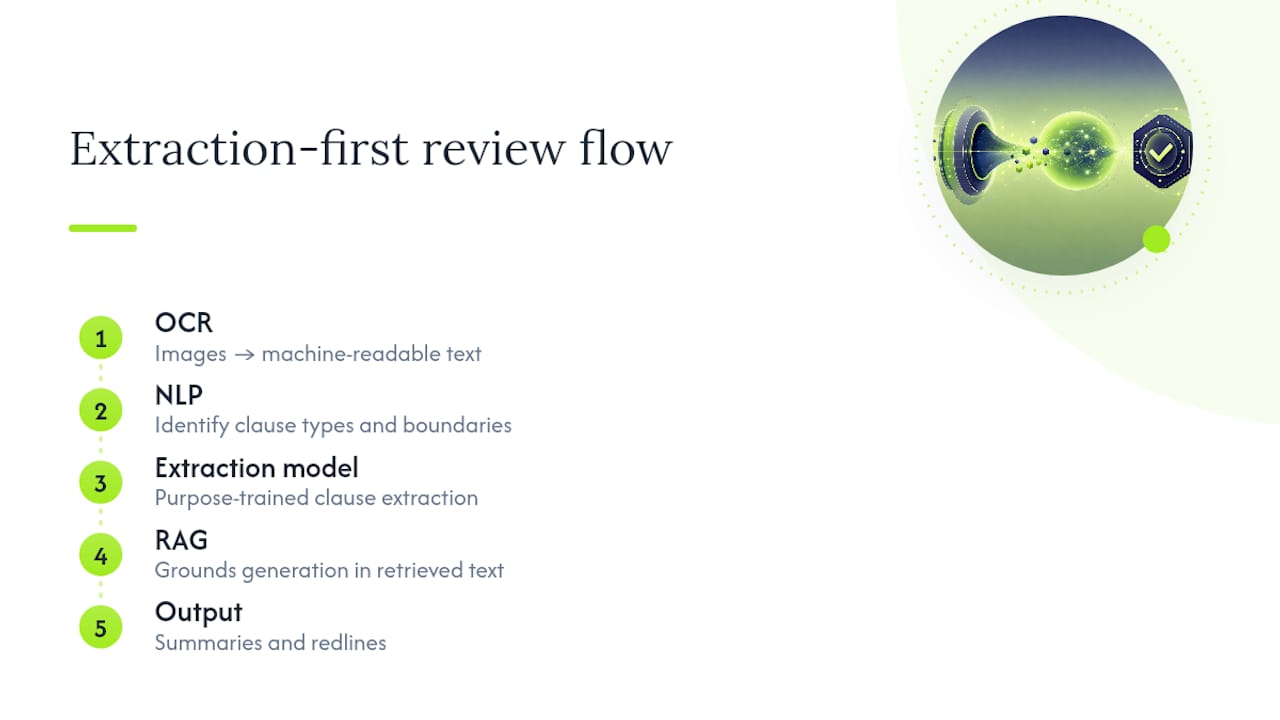
That pairing is often called retrieval-augmented generation, or RAG. Instead of asking a chatbot to recall what an indemnification clause should say, RAG grounds every generated summary or redline in the actual retrieved text from the document. This matters because general-purpose language models can hallucinate legal facts when they aren't grounded in source text, a risk Stanford's Institute for Human-Centered AI has documented as a persistent problem across legal applications.
Pro Tip: Ask any vendor directly whether their platform uses extraction-first architecture or a chat interface layered on a general LLM. The answer tells you more about accuracy than any marketing page will.
No system is immune to edge cases. Ambiguous language, unusual clause structures, and contracts translated from another jurisdiction still produce boundary errors that need a trained eye.
Features That Actually Move the Needle
Vendor feature lists tend to blur together. What separates a genuinely useful platform from a glorified search tool comes down to five capabilities that directly affect risk reduction and speed.
Playbooks and clause libraries. Your standards, codified once and applied automatically across every contract, so a reviewer isn't relitigating the same negotiating position every time.
Citation to clause and page. Every flagged risk should point to the exact source text. A finding you can't verify against the actual document isn't a finding, it's a guess.
Batch and portfolio review. The ability to run hundreds of agreements at once, with results aggregated for a due diligence data room or an internal audit.
Native editor integration. Redlines that land inside Word or Google Docs, not a separate export you have to reconcile manually.
Collaboration and approval routing. Built-in workflows so a flagged clause moves to the right reviewer without a separate email thread.
Security deserves its own line item, not an afterthought. Certification against recognized security industry standards and defined access controls indicate a vendor takes contract confidentiality seriously, given that the documents flowing through these systems are often your most sensitive corporate records.
Pro Tip: During a demo, ask the vendor to click through from a flagged risk directly to the source clause. If that path takes more than two clicks, or doesn't exist, treat it as a red flag.
Who Benefits and What the Workflows Look Like
The value of AI contract review shifts depending on where you sit in an organization. Matching the tool to the actual workflow determines whether adoption sticks past the pilot phase.
In-house legal teams get the most immediate payoff on routine, repeatable documents: NDAs, MSAs, and renewal cycles that follow predictable patterns and rarely need novel legal analysis.
M&A due diligence teams use bulk review to process data rooms containing hundreds of agreements, isolating change-of-control clauses and IP assignment provisions that could derail a deal.
Procurement and finance teams rely on it to track vendor contracts, SLA commitments, and renewal dates across a sprawling supplier base that no spreadsheet keeps current.
Private equity and venture-backed portfolio companies sit in a category of their own here. Many don't have a general counsel, let alone a legal ops function, yet they're expected to meet the same audit-readiness bar as the fund's other holdings the moment a follow-on round or exit process starts.
"Portfolio companies rarely have the bandwidth to build a legal ops function from scratch, so the tooling has to do double duty: fast enough for a lean team, rigorous enough for the fund's diligence standards." — Oyster Shield, a legal operations specialist for PE and VC-backed companies
Human-only review still holds a firm place in this picture. Novel deal structures, high-stakes negotiations, and any contract where the downside of a missed nuance outweighs the time saved deserve a lawyer's full attention from the start, with AI serving as a second pass rather than the first.
Implementation and Responsible Use: A Rollout That Actually Works
Buying the software is the easy part. Rolling it out in a way that satisfies both your risk tolerance and your professional obligations takes more planning.
The American Bar Association's guidance on AI and legal document review recommends establishing clear guidelines, human oversight, and dedicated training before scaling any AI tool across a legal team. The ABA goes further in its broader guidance on AI in legal practice, framing human oversight as an ethical requirement rather than an optional safeguard, meaning lawyers stay responsible for verifying AI-generated citations and redlines regardless of how confident the output looks.
Design the pilot narrowly. Pick one contract type, a defined sample size, and a clear accuracy threshold before you start.
Measure both directions. Track time saved and missed-find rates. A tool that's twice as fast but misses one in ten high-risk clauses isn't a net win.
Vet the vendor's security posture. Confirm compliance with recognized security industry standards, data retention policy, and backup practices before contracts leave your firewall.
Train reviewers on the playbook. Set escalation rules for anything the system flags as uncertain, and define who signs off before a redline goes out the door.
Pro Tip: Build the human-in-the-loop requirement into your vendor contract itself, not just your internal policy. It gives your governance teeth if expectations slip later.
Dilicheck's blog covers practical checklists for this kind of rollout in more depth, including how to structure reviewer sign-off for audit purposes.
An Evaluation Checklist That Skips the Brand Comparisons
Demos are designed to impress, not inform. A short checklist keeps the conversation on capabilities you can actually verify rather than a polished walkthrough.
Evidence trail: Does every flagged risk cite the clause and page it came from, and can you export an audit log showing who reviewed what?
Documented accuracy: Ask for false-negative and false-positive rates on sample tests, not just a general accuracy percentage.
Playbook customization: Can the system train on your historical contracts and negotiated positions, or does it only apply a generic template?
Integration and throughput: Does it plug into your existing editor and CLM system, and what's the realistic daily document capacity?
Commercial structure: Is pricing based on seats, document volume, or a flat license, and does the vendor offer a genuine pilot before you sign a full-term contract?
Total cost of ownership rarely shows up on the first pricing page. Beyond the license fee, budget for setup time, playbook configuration, reviewer training hours, and any per-document overage charges that kick in once you exceed your contracted volume. Most organizations see initial productivity gains within the first month of a well-scoped pilot, with full return on investment typically following once the playbook is tuned and reviewers trust the flagged output enough to stop double-checking everything by hand.
Comparative Analysis of Leading AI Contract Review Tools
Rather than ranking specific products, the more useful comparison sorts platforms by architecture and target use case, since that's what actually predicts performance for your contracts.
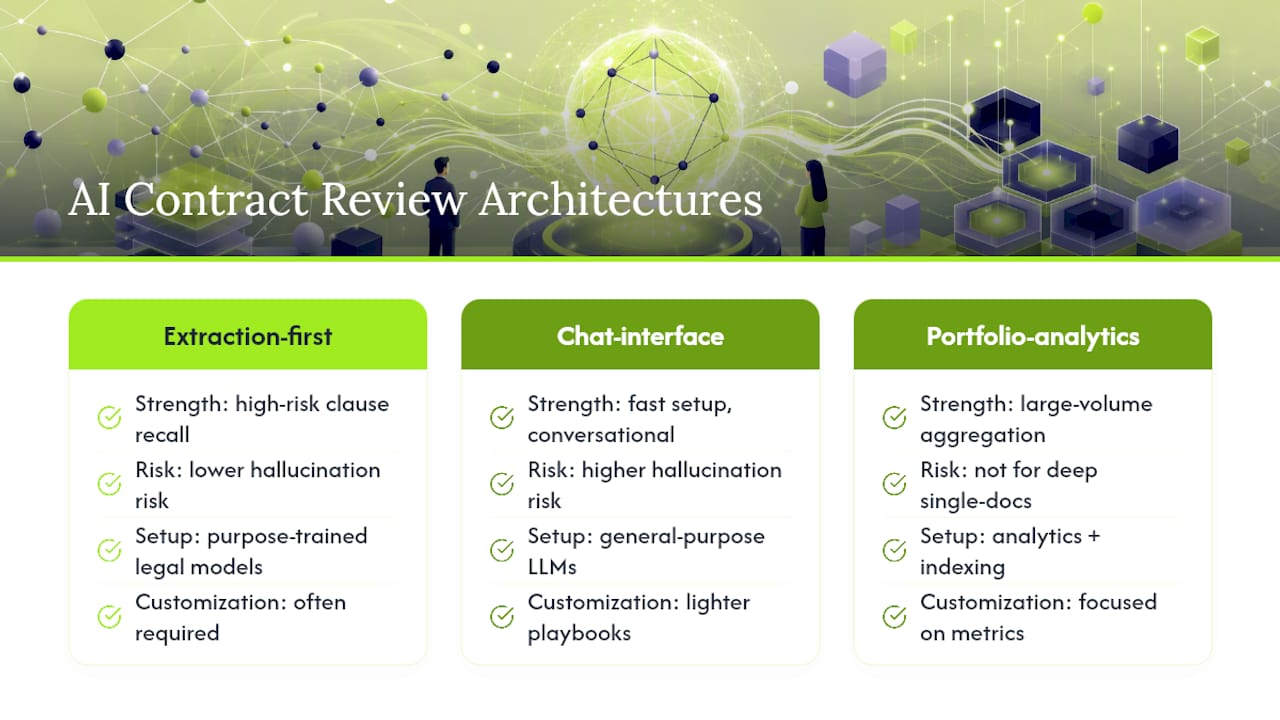
Extraction-first platforms built on purpose-trained legal models tend to outperform on high-risk clause recall, the exact advantage the Cambridge Judge Business School research identified for specialized models over general-purpose ones. These platforms suit teams where a missed indemnification clause or an overlooked change-of-control provision carries real financial exposure, such as M&A due diligence.
Chat-interface platforms layered on general-purpose language models offer faster setup and a more conversational feel, but carry higher hallucination risk without strong grounding, per the Stanford HAI findings cited earlier. These tend to fit lower-stakes, high-volume tasks like initial NDA triage, where a human reviewer catches errors downstream anyway.
Portfolio-analytics platforms emphasize aggregation across large contract volumes rather than deep single-document analysis. They fit procurement and finance teams tracking renewal dates and SLA compliance across hundreds of vendor agreements more than they fit a legal team doing deep single-contract negotiation.
None of these categories is universally superior. The right fit depends on your contract volume, risk tolerance, and how much customization your playbook actually needs. A team running due diligence for a fundraising round has different requirements than a procurement group tracking software vendor renewals, and the architecture that serves one poorly might serve the other well.
Vendor Selection Criteria and Questions to Ask
Every vendor conversation should include a specific set of questions that cut through the marketing copy and get to what the platform can actually verify.
Start with architecture: does the platform use a dedicated extraction model, a general LLM, or a hybrid, and how does the vendor validate accuracy on your specific contract types rather than a generic benchmark set? Ask for a sample accuracy report on a document type similar to yours, not an aggregate score across an unrelated dataset.
Move to data handling next. Where is your contract data stored, who has access, and does the vendor hold current certification against recognized security industry standards? Confirm whether your data trains the vendor's models for other customers, since that answer affects both confidentiality and competitive exposure if you're in a sensitive industry.
Ask about playbook portability. If you switch vendors in three years, can you export your trained playbook and historical redline data, or does switching mean starting from zero? Lock-in risk is real in this category, and few vendors volunteer the answer unprompted.
Finally, press on support during the pilot itself. Who configures the initial playbook, how many revision rounds are included, and what does the escalation path look like when the system flags something ambiguous? A vendor confident in their accuracy will walk you through failure cases, not just success stories.
Common Red Flags and Pitfalls When Choosing a Solution
A few warning signs show up repeatedly across procurement processes for this category, and each one predicts trouble after the contract is signed.
The first is a vendor that won't show you a false-negative rate. If a platform can't tell you how often it misses a clause it should have flagged, you have no basis for trusting its risk scores on your own contracts. Marketing accuracy claims without a documented methodology behind them are not evidence.
The second is missing evidence trails. If a flagged risk doesn't link back to the specific clause and page in the source document, you can't verify it, and neither can outside counsel or an auditor reviewing your process later. This is non-negotiable for anything feeding into due diligence or compliance reporting.
The third is opaque pricing that only reveals overage charges after you've committed. Ask upfront what happens when you exceed your contracted document volume, and get it in writing before signing.
The fourth is a sales process that avoids letting you test the platform on your own contracts. A vendor confident in its accuracy will let you run a pilot on real, messy documents from your own portfolio, not a curated demo set chosen to look impressive.
The fifth, and most overlooked, is a platform with no clear human-in-the-loop workflow. If the tool is positioned as a replacement for reviewer judgment rather than an accelerant for it, that's a governance problem waiting to surface during an audit.
Case Studies or User Testimonials Demonstrating Value
Independent benchmark data in this category remains limited, and vendor-published case studies should be read with that in mind. Speed claims from product pages report manual contract review running roughly two to three minutes per page, with AI-assisted review dropping that to under a minute in some controlled benchmark tests, though results vary meaningfully depending on contract complexity and the specific dataset used.
The more defensible pattern, borne out across multiple sources in this space, is that speed gains only translate into real value when paired with disciplined error tracking. A pilot that measures time saved without also measuring missed-find rates tells you half the story. Teams that scale AI contract review successfully tend to run a defined pilot period first, track both metrics side by side, and only expand usage once the accuracy numbers hold up on their actual contract types, not a vendor's demo set.
Rather than treating a single glowing testimonial as proof, ask any vendor for their own documented pilot methodology, then replicate a version of it internally before trusting the tool with anything high-stakes.
Author Perspective: Practical Rules From Legal Operations
Start AI contract review on your highest-volume, lowest-risk documents. NDAs and routine renewals build trust in the tool before you ever point it at a live M&A data room. Track missed-find rates alongside speed gains from day one. A platform that saves four hours but misses a change-of-control clause has cost you more than it saved.
Prioritize auditability over flash. If you plan to scale toward M&A or investor-facing work, the ability to show a clean evidence trail matters more than a slick interface.
— Matias Toye
Dilicheck: How This Platform Maps to Your Checklist
Everything on the evaluation checklist above points toward one underlying question: can a platform show its work, at scale, without turning your legal team into full-time reviewers? The platform is built around that exact requirement, combining playbook-driven contract review with portfolio-wide analytics so findings stay traceable back to the source clause rather than sitting in a black box.
For portfolio companies, private equity firms, and in-house legal teams juggling audit readiness alongside daily contract volume, Dilicheck centralizes documents, obligations, and risk findings in one dashboard instead of scattering them across email threads and shared drives. If you're preparing for a fundraising round or exit, the platform's approach lines up closely with the readiness steps outlined in this SaaS due diligence checklist. Run a pilot on your own contract portfolio and see how the findings hold up against your playbook before scaling further.
For companies without in-house legal ops to run that pilot, or a legal team too stretched to take it on, an alternative legal services provider like Oyster Shield can sit in the gap. Think of it as a forward deployed lawyer model: instead of a portfolio company hiring a full legal ops function, a fractional legal lead embeds directly in the workflow, configuring the playbook, reviewing flagged findings, and signing off on redlines, so the fund's diligence bar gets met without adding headcount.
This article is general information, not a substitute for advice from a qualified lawyer. Consult a qualified legal professional about your own circumstances before acting on anything here.
Sources
Specialised AI models show big advantage in precision tasks — JBS (2025)
How AI enhances legal document review — American Bar Association (2025)
Hallucinating law: legal mistakes from large language models — HAI Stanford
Recommended
Ready to automate your due diligence?
Get a free healthcheck of your company's audit readiness. No credit card required.
Related articles
Cut Cycle Time in Legal Ops: 5 Pilot Contract Management Best Practices
The highest-impact contract management best practices come down to five moves: centralize every agreement in one searchable repository, standardize templates and clause libraries, assign clear RACI ownership, automate intake and approval routing, and track KPIs like cycle time and renewal accuracy. This guide breaks the work into a prioritized list, a phased rollout, and the metrics that prove it's working.
Avoid the 72 Hour Breach Trap in Data Processing Agreements
A practical guide to data processing agreements: what GDPR Article 28 requires, how to structure and negotiate a DPA, where compliance programs actually break down after signing, and the Article 27 representative requirement that catches non-EU/UK companies off guard.
Roll Out Private Equity Legal Operations and Cut DDQ Time
Legal operations creates value across the whole private equity ownership lifecycle — acquisition, first 100 days, hold period, bolt-ons and exit — not just at the diligence stage. This guide covers continuous legal readiness, the people-process-technology-accountability framework, portfolio legal health baselines with permissioned reporting, contract intelligence beyond renewal dates, and legal resource management beyond invoice review.