Roll Out Private Equity Legal Operations and Cut DDQ Time
Private equity legal operations means running due diligence, contract and entity management, compliance tracking, and outside counsel spend through one connected system instead of scattered spreadsheets and inboxes. But the deeper shift underway in PE-backed portfolios is not about swapping tools — it is about treating legal readiness as continuous rather than episodic. A portfolio company's legal function touches every stage of the ownership period: the acquisition itself, the first 100 days, the hold period, each bolt-on, and eventually exit. Done well, legal operations gives operating partners and portfolio company legal teams centralized visibility, faster diligence cycles, and a legal file that is always audit-ready, not just ready when a deal forces the issue.
TL;DR:
Legal operations creates value across the entire PE ownership lifecycle — acquisition, first 100 days, hold period, bolt-ons and exit — not just as a one-off diligence exercise.
Technology alone does not close legal risk. A platform can surface a missing agreement or an overdue filing, but someone still has to own remediation, coordinate stakeholders, and keep the record current — the discipline of people, process, technology and accountability together.
A portfolio legal health baseline set shortly after acquisition, paired with permissioned reporting, gives sponsors risk visibility without requiring access to privileged or commercially sensitive documents.
Contract management is evolving into contract intelligence: surfacing change-of-control, assignment and liability provisions before they affect a transaction, not just tracking renewal dates.
Outside counsel spend management is evolving into legal resource management — routing each matter to the right resource, at the right cost, with the outcome captured for next time.
Fragmented systems hinder risk reporting and reduce buyer confidence; centralizing on one platform, rolled out in phases with clear ownership, improves diligence speed and demonstrates governance to investors and buyers.
Table of Contents
The Private Equity Ownership Lifecycle: Where Legal Operations Creates Value
People, Process and Technology: Why the Platform Alone Isn't Enough
Core Capabilities Checklist for Private Equity Legal-Ops Platforms
How to Evaluate and Roll Out a Legal-Operations SaaS Across a Portfolio
Security and Data Privacy Considerations for Legal-Ops Platforms
Case Studies in Legal Operations Transformation Across PE Portfolios
Practitioner Perspective: How Operating Partners and GCs Create Value
Why Dilicheck Is a Practical Option for Private Equity Legal Operations
What Private Equity Legal Operations Actually Covers
Legal operations in finance is not a single tool. It is a set of connected workflows that a portfolio company's legal or finance team runs every week, whether or not anyone calls it "legal ops."
The core functions look like this:
Due diligence automation — AI-assisted review of contracts, corporate records, and compliance files to answer diligence questionnaires without a manual document hunt.
Contract lifecycle management — tracking key agreements, renewal dates, and obligations across every portfolio entity, not just the parent company.
Entity management — maintaining corporate records, board minutes, cap tables, and subsidiary structures in one system of record.
Compliance obligation tracking — monitoring regulatory deadlines, data privacy requirements, and filing calendars before they become fire drills.
Outside counsel spend management — visibility into legal invoices, matter budgets, and work in progress before the bill arrives.
Each function feeds the next. A missed contract renewal shows up as a compliance gap. A compliance gap shows up as a diligence flag during a sale process. That is why private equity compliance and contract management can't be evaluated as separate problems.
The clearest illustration is the due diligence questionnaire. A portfolio company facing a 200-question DDQ ahead of an add-on acquisition traditionally spends days pulling documents from shared drives and emailing department heads for answers. With document-level AI analysis, that same response window can shrink from days to under an hour, because the system already knows which contracts, policies, and entity records answer each question.
The Private Equity Ownership Lifecycle: Where Legal Operations Creates Value
Most conversations about legal operations start and end with diligence, because diligence is where legal risk becomes visible and expensive all at once. That framing understates the opportunity. Legal operations creates value at every stage of a PE holding period, and the companies that treat it as a one-off transaction event tend to rebuild the same readiness file from scratch each time a deal, a filing, or an LP report demands it.
Acquisition. Legal operations supports due diligence directly: capturing documents and data in a structured way, establishing an initial legal-risk baseline, and flagging the remediation items that will need attention regardless of whether the deal closes.
First 100 days. The baseline becomes a roadmap. This is when corporate and entity clean-up happens, contracts get migrated into a live system of record, compliance gaps get remediated, and the core legal processes the portfolio company will run for the next several years get put in place.
Hold period. Legal operations shifts from clean-up to maintenance: ongoing contract management, compliance monitoring, entity governance, legal-spend oversight, and continuous legal-risk visibility, so nothing quietly decays between deals.
Bolt-ons. Every add-on acquisition repeats the acquisition-stage workload — diligence, onboarding, and integration — but a portfolio company with a mature legal-ops foundation does it faster, because the process for harmonizing a new entity's contracts, policies, and compliance posture into the existing structure already exists.
Exit. The payoff for continuous readiness shows up here: an exit-readiness assessment becomes a formality rather than a scramble, outstanding issues are already known and prioritized, the virtual data room can be assembled from current records instead of reconstructed from scratch, and buyer diligence questions get answered faster because the underlying data was never allowed to go stale.
The concept underneath all five stages is continuous legal readiness — treating the legal file as a living operating asset that is always current, rather than a project that gets reopened under deadline pressure.
Why Legal Visibility Matters for Operating Partners and LPs
Operating partners rarely lack ambition around governance. They lack a clear line of sight into what is actually happening inside each portfolio company's legal function. Fragmented systems (one company on shared drives, another on a legacy CLM, a third tracking obligations in a spreadsheet) make it nearly impossible to run portfolio-wide risk reporting or spot patterns across holdings.
That fragmentation has a direct cost at exit. Buyers and their counsel expect clean, centralized documentation. When legal governance and audit-readiness are handled well, diligence moves faster and buyer confidence goes up, because there is less back-and-forth chasing missing records.
Industry signal: Legal operations teams supporting PE-backed companies are increasingly expected to move from invoice-based reconciliation to mid-matter visibility into work in progress, so legal spend can be forecast rather than discovered after the fact.
LPs have absorbed this expectation too. Investor reporting now often includes governance and compliance posture alongside financial performance. A fund that can show consistent legal operations across its portfolio, not just at the deals it happens to spotlight, builds a stronger case in its own fundraising cycle. Operating partners who want cross-portfolio thematic reporting, like tracking which companies share the same risky clause language or the same overdue regulatory filing, need a system that aggregates at the fund level, not just company by company.
People, Process and Technology: Why the Platform Alone Isn't Enough
A legal-ops platform is very good at one thing: surfacing what is wrong. It can identify a missing agreement, a contractual risk buried in a renewal clause, an overdue corporate filing, a compliance gap, an upcoming contractual obligation, or missing legal documentation, often faster and more consistently than a manual review ever would.
Identifying the issue is only the first step. Someone still has to decide who owns it, coordinate with the relevant stakeholders and external counsel, actually remediate it, and keep the underlying record current afterward so the same issue doesn't resurface at the next deal. A platform without that discipline behind it turns into a very well-organized list of problems nobody is accountable for fixing.
The technology layer is only one part of the equation. Oyster Shield, a legal operations and managed legal services provider working with PE-backed and fast-growing businesses, frames its own work around combining people, process and technology to deliver results for clients — a useful shorthand for the same point: identifying legal risk only creates value if there is also a process for assigning ownership, resolving issues, and maintaining the information afterward. (Oyster Shield)
In a private equity environment, that distinction matters more than usual, because the "someone" responsible for remediation is often stretched across a lean portfolio-company legal function, a fund-level operating partner, and outside counsel brought in for a specific matter. The framework worth holding onto is people, process, technology and accountability — the platform is the layer that makes the other three possible to run consistently across a portfolio, not a replacement for them.
Core Capabilities Checklist for Private Equity Legal-Ops Platforms
Corporate legal management tools for PE portfolios vary widely in scope. Before you compare vendors, it helps to know exactly which capability categories matter and what a good outcome looks like for each one.
Diligence automation. Success looks like AI-assisted contract and document review that turns DDQ responses around in hours, not weeks.
Contract lifecycle management. Success looks like standardized contract playbooks and renewal alerts applied consistently across every portfolio company, not just the ones with dedicated legal staff — and, increasingly, the ability to surface the specific provisions (change-of-control, assignment, liability caps) that matter most to a PE transaction, not just the renewal date.
Entity management. Success looks like automated entity reports and resolution tracking, so board minutes and subsidiary records are diligence-ready without a scramble.
Compliance obligation tracking. Success looks like a single calendar of regulatory, privacy, and filing deadlines visible to legal, finance, and operating partners alike.
Spend and work-in-progress visibility. Success looks like real-time tracking of outside counsel spend against budget, before invoices land — paired with a clear view of which matters are even suited to outside counsel in the first place.
Integrations. Success looks like the platform connecting to existing document repositories, ERP, and cap table systems without requiring a rebuild of existing IT infrastructure.
Security and access controls. Success looks like role-based permissions that separate what a portfolio company team sees from what the fund-level operating partner sees.
Standardizing these categories across a portfolio also sharpens the investment story you tell buyers. A fund that can point to consistent contract playbooks and compliance tracking across five portfolio companies, rather than five different ad hoc systems, presents a cleaner risk profile in any sale process.
Pro Tip: Before you evaluate any vendor's feature list, map your fund's own reporting taxonomy first. A platform's data model needs to match how your LPs expect to see risk and spend categorized, or you'll end up doing manual translation work every quarter regardless of how good the software is.
From Contract Management to Contract Intelligence
Renewal dates and obligation tracking were the first generation of contract management, and they are still necessary. But for a PE-owned portfolio, "we know when the contract renews" is a low bar. The provisions that actually affect a transaction, a refinancing, or a valuation rarely show up on a renewal calendar at all.
Structured contract intelligence looks for the clauses that matter at the moments that matter, including:
Change-of-control restrictions
Assignment restrictions
Termination rights
Uncapped liability
Indemnities
Exclusivity provisions
Most-favoured-nation clauses
Customer concentration
Renewal and indexation provisions
Data-protection obligations
Intellectual-property provisions
Significant service-level commitments
The difference in practice is the difference between finding out during a live acquisition, refinancing, bolt-on, or exit that a key customer contract terminates on change of control, and already knowing that going in. The first scenario is a delay, or a valuation adjustment, discovered under deal pressure. The second is a known quantity the deal team priced in months earlier. Contract intelligence is what turns a repository of PDFs into something a deal team can actually query when it needs an answer fast.
Building a Portfolio Legal Health Baseline
Shortly after acquisition, a portfolio company and its sponsor can establish a standardized legal baseline — a single, structured snapshot of legal health across the areas that tend to matter most over a hold period:
Corporate and entity records
Material contracts
Employment and HR
Intellectual property
Privacy and data protection
Regulatory compliance
Insurance
Disputes and litigation
Policies and governance
Legal spend and external counsel
The baseline is useful precisely because it is standardized: it turns "how healthy is this company's legal function" from a subjective impression into a structured remediation roadmap, with specific gaps assigned to specific owners and timelines, from the first 100 days onward.
At the portfolio level, operating teams generally want visibility into a narrower set of indicators drawn from that baseline: overall legal-readiness status, the number of high-risk issues open across the portfolio, overdue remediation actions, documentation completeness, and any significant blockers to a future transaction. That is a legitimate and useful ask — but it is different from asking for the underlying documents themselves.
This is where permissioned portfolio intelligence matters. Portfolio companies retain control over the privileged, confidential, and commercially sensitive legal information underneath the baseline, while the sponsor receives an agreed layer of dashboards, risk indicators, and progress reporting on top of it. The sponsor gets the visibility needed to manage portfolio-wide risk; the portfolio company keeps control over material it has good reason not to expose unrestricted, even to its own owner.
From Outside Counsel Spend to Legal Resource Management
Outside counsel spend management usually starts as invoice review: checking bills against budget after the fact. That catches overspend, but only after the money is already committed. The more useful discipline is upstream of the invoice, and it applies to every matter a legal function handles, not just the ones sent to a law firm.
A mature legal-ops process runs each matter through a consistent sequence:
Matter triage → Appropriate resource → Scope → Budget → WIP → Delivery → Knowledge capture
In practice, that means asking, before a matter goes anywhere:
Does this actually require external counsel, or can it be handled internally?
If it needs outside support, does it need a full-service law firm, or can it be handled by a lower-cost alternative legal resource for the type of work involved?
What is the matter scoped to cost, and is spend tracked against that budget while the matter is still open, not just when the invoice arrives?
What did the matter actually resolve to, and is that outcome captured so the next similar matter doesn't start from zero?
The value of legal resource management over simple spend tracking is that it changes a recurring cost center into a source of institutional memory: the same type of dispute, the same category of contract negotiation, or the same compliance question tends to come up again across a portfolio, and a team that captures the resolution the first time spends less resolving it the second and third time.
How to Evaluate and Roll Out a Legal-Operations SaaS Across a Portfolio
Selecting a platform is a different exercise than rolling one out. Treat them as two separate decisions.
Selection criteria to weigh:
Data ingestion: can it handle the messy mix of PDFs, scanned contracts, and legacy records most portfolio companies actually have?
AI accuracy: does it flag the right clauses and obligations, and how transparent is it about confidence levels?
Integrations: does it connect to your existing document, finance, and entity systems?
Security: what certifications and access controls does it support for multi-entity, multi-user environments?
Multi-entity support: can it handle a holding structure with several subsidiaries under one fund?
Measurable ROI: does the vendor point to specific efficiency gains, not just general promises?
A phased rollout works better than an all-at-once deployment:
Pilot with one portfolio company, measuring DDQ turnaround time and outside counsel spend variance against your prior baseline.
Cohort rollout to a small group of similar companies once the pilot proves out.
Governance and training to standardize how legal, finance, and operating partners use the shared data.
LP reporting configuration so exit and investor dossiers pull automatically instead of getting rebuilt by hand each quarter.
Track adoption with concrete metrics: DDQ response time, outside counsel spend as a share of revenue, contract obligation closure rates, and the number of post-close remediation items after a sale. During procurement, ask vendors directly how their data model maps to fund-level reporting, and ask internal stakeholders whether the platform will actually replace their current spreadsheet habits or just add another login to ignore.
Change Management Strategies Specific to PE Firms
The technical rollout is rarely the hard part. Getting a portfolio company's legal team, most of whom did not choose the software, to actually use it consistently is where most legal-ops projects stall.
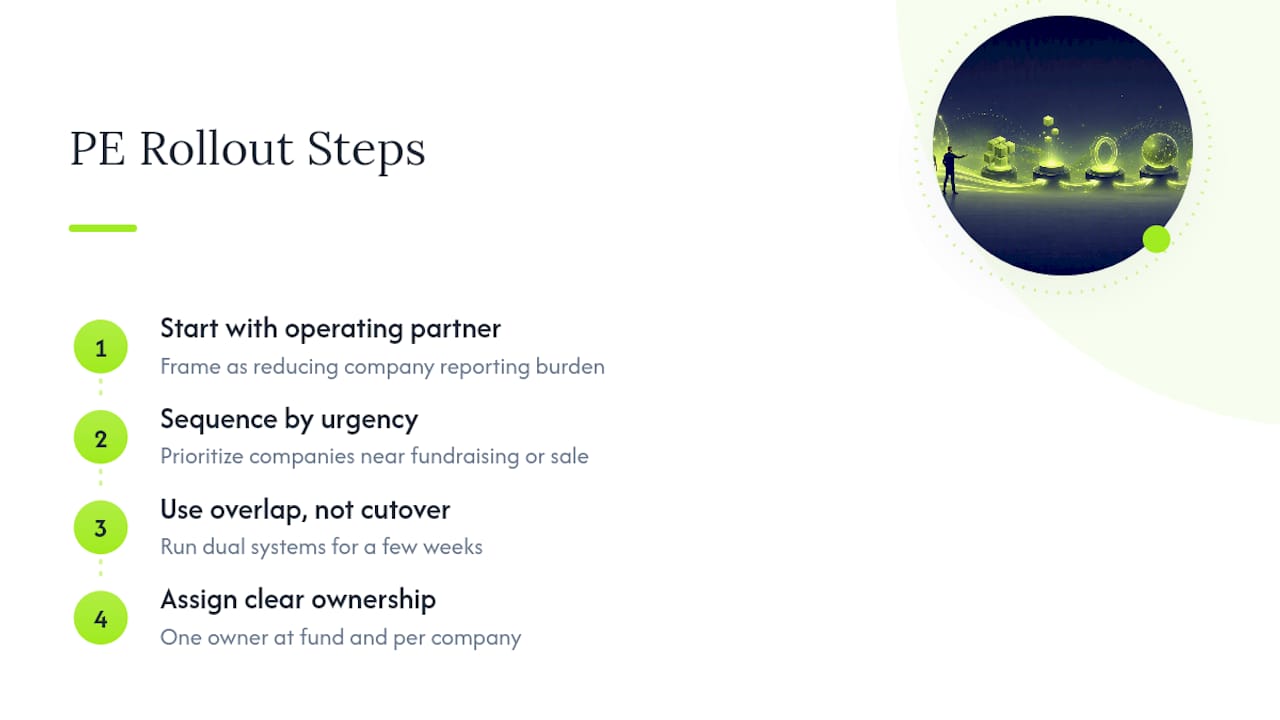
Start with the operating partner relationship, not the software. Portfolio company general counsel and finance leads respond better when a new platform is framed as reducing their own reporting burden, not adding fund-level oversight for its own sake. If the tool only ever produces reports for the fund and never saves the portfolio company team any time, adoption will erode within a quarter.
Sequence the rollout by urgency, not convenience. Companies approaching a fundraising round or an active sale process benefit most immediately from centralized diligence and entity records, so they make natural early adopters and internal advocates. Their results become the case for the next cohort.
Build in a short overlap period rather than a hard cutover. Legal teams that keep dual systems running for a few weeks while they trust the new platform's outputs tend to convert faster than teams forced to abandon familiar tools overnight.
Finally, assign clear ownership at both levels. One person at the fund and one at each portfolio company should own data quality and adoption metrics, because a platform with no accountable owner tends to decay back into the fragmented systems it replaced within a year.
Security and Data Privacy Considerations for Legal-Ops Platforms
A legal operations platform in a PE context holds some of the most sensitive material in the fund: cap tables, board minutes, unreleased financials referenced in contracts, and compliance records that touch employee and customer data.
Role-based access control matters more here than in a typical corporate legal department, because a PE legal-ops platform usually serves multiple audiences at once: portfolio company legal teams, fund-level operating partners, and sometimes outside counsel or auditors during a sale process. Each of those groups needs a different slice of visibility, and getting that wrong either blocks legitimate work or exposes data that should stay compartmentalized between portfolio companies. This is the same logic behind permissioned portfolio intelligence: the sponsor's dashboard and the portfolio company's underlying record are two different things, by design.
Data residency and retention policies deserve specific attention if your portfolio spans multiple regulatory jurisdictions, since privacy compliance requirements differ by region and by the type of data a contract or entity record contains. Ask any vendor directly how they handle encryption at rest and in transit, how long they retain data after a contract ends, and whether they support the audit logging your fund's own compliance function requires.
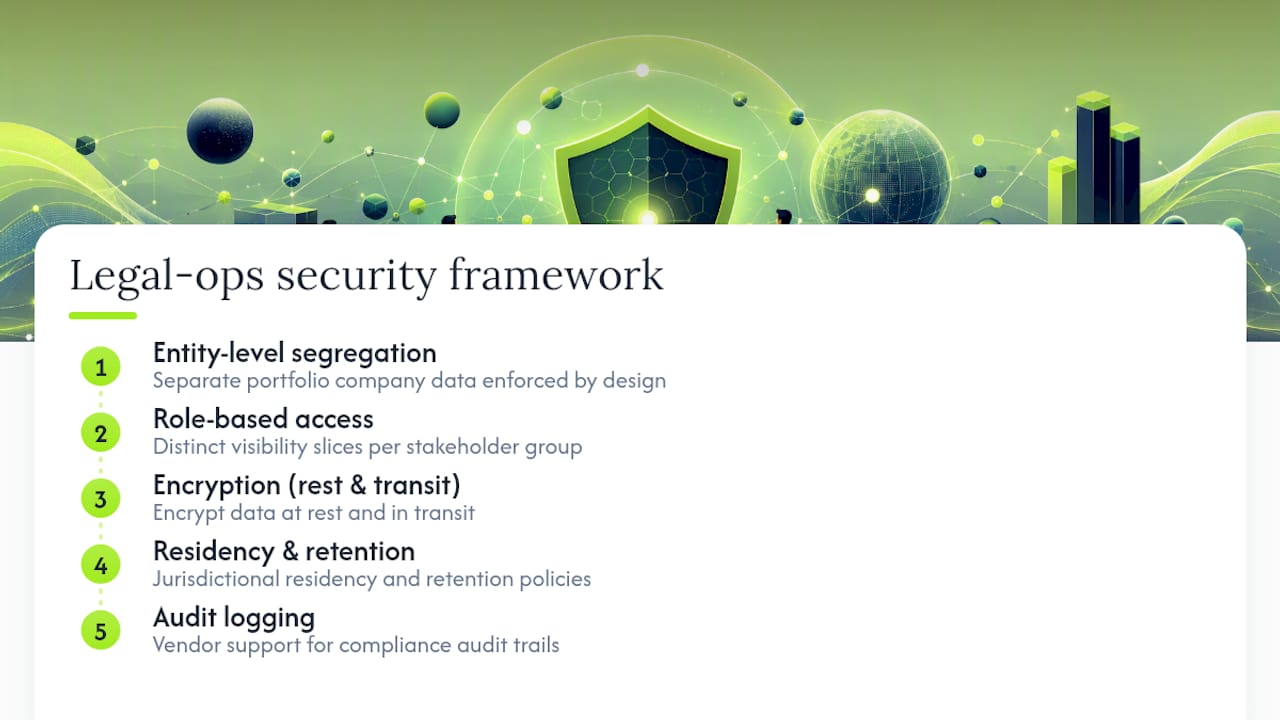
Multi-entity structures raise a specific risk: a platform that is not built for holding company hierarchies can accidentally blend data across portfolio companies that should remain separate, both for competitive reasons and for legal ones. Confirm before rollout that entity-level data segregation is enforced by design, not just by convention.
Case Studies in Legal Operations Transformation Across PE Portfolios
The pattern that shows up across PE-backed companies that successfully modernize legal operations is consistent: they start narrow, prove a measurable win, and expand from there.
A portfolio company preparing for an add-on acquisition is a common starting point, because diligence pressure creates urgency that a general "let's improve our systems" initiative never does. Teams that centralize contracts and entity records before that first bolt-on deal typically report that the second and third add-ons move noticeably faster, since the underlying data structure is already in place.
Another recurring pattern involves compliance-heavy portfolio companies, particularly those handling regulated data or operating across multiple jurisdictions. Centralizing obligation tracking here tends to surface overdue filings and lapsed policies that had been sitting unnoticed across departments, which is uncomfortable in the short term but far better discovered internally than during a buyer's diligence process.
The common thread across these transformations is that the win rarely comes from the software alone. It comes from treating entity records, contracts, and compliance obligations as first-class, continuously updated data rather than static files pulled out only when a deal or an audit forces the issue — the same continuous-readiness principle that runs through the acquisition-to-exit lifecycle.
Practitioner Perspective: How Operating Partners and GCs Create Value
The gap between what legal ops software promises and what actually moves the needle for a PE portfolio comes down to three things: thematic pattern detection, synchronized deadlines, and speed on add-ons.
Operating partners get the most value not from per-company dashboards but from thematic reports across the whole portfolio: which companies share the same risky indemnification language, which ones have compliance filings clustering around the same overdue date. That kind of aggregation is only possible when every portfolio company feeds the same underlying data model, which is exactly the discipline effective GCs in PE environments already need to bring to a fast-moving, lean legal function.
Add-on acquisitions are where the speed argument gets tested. A portfolio company that has already standardized its entity records and contract data closes bolt-on deals noticeably faster than one starting from scratch each time.
The failure modes are predictable. Data quality problems undermine trust in the system faster than any feature gap. Scope creep, trying to digitize every legal process on day one, kills pilots before they prove anything. And user adoption fails quietly when the tool serves the fund's reporting needs but never saves the portfolio company team any actual time.
— Matias
Why Dilicheck Is a Practical Option for Private Equity Legal Operations
If you have been mapping your own checklist against the categories above, some platforms are built around exactly that list. It centralizes due diligence automation, contract lifecycle management, entity management, compliance obligation tracking, and outside counsel spend visibility into one platform, so portfolio companies stop rebuilding the same diligence file from scratch every time a fund asks for one.
That means a portfolio company can run its everyday legal operations on the same system that keeps it continuously audit-ready and investor-ready across the full acquisition-to-exit lifecycle, while the fund gets consistent, permissioned visibility across every holding instead of a patchwork of spreadsheets and inbox threads. AI-driven document analysis surfaces contract risks and compliance gaps automatically, cutting the manual review time that usually eats up a legal team's week.
If you want to see how this fits your own portfolio, start with the Dilicheck platform to explore the core capabilities, or work through the SaaS due diligence readiness checklist to see exactly where your current documentation stands before your next deal or LP review.
Sources
For deeper context on operating partner visibility and PE legal ops priorities, see Lexology on legal blind spots and PERSUIT's PE legal ops guide. Continue on Dilicheck's blog for ongoing coverage.
Recommended
Ready to automate your due diligence?
Get a free healthcheck of your company's audit readiness. No credit card required.
Related articles
Cut Cycle Time in Legal Ops: 5 Pilot Contract Management Best Practices
The highest-impact contract management best practices come down to five moves: centralize every agreement in one searchable repository, standardize templates and clause libraries, assign clear RACI ownership, automate intake and approval routing, and track KPIs like cycle time and renewal accuracy. This guide breaks the work into a prioritized list, a phased rollout, and the metrics that prove it's working.

Avoid the 72 Hour Breach Trap in Data Processing Agreements
A practical guide to data processing agreements: what GDPR Article 28 requires, how to structure and negotiate a DPA, where compliance programs actually break down after signing, and the Article 27 representative requirement that catches non-EU/UK companies off guard.
AI Contract Review: Audit Ready Results and a Buyer's Checklist
A buyer's guide to AI contract review: how the technology actually works, the features that matter, a vendor evaluation checklist, common red flags, and where Dilicheck fits.