Avoid the 72 Hour Breach Trap in Data Processing Agreements
Avoid the 72 Hour Breach Trap in Data Processing Agreements
A data processing agreement is the written contract required whenever a controller hands personal data to a processor to handle on its behalf. GDPR Article 28 makes this mandatory in the European Union, and US state privacy laws like the CCPA and CPRA push most American vendors toward the same practice by contract. If your company shares personal data with a SaaS vendor, payroll provider, or cloud host, you need a signed DPA with that vendor before the data moves.
TL;DR:
A DPA must include detailed information on processing scope, duration, data types, and data subject categories as required by GDPR Article 28.
Operational duties in the DPA include processing only on documented instructions, ensuring confidentiality, and assisting with data rights requests.
Most operational failures occur after signing, such as poor tracking of sub-processors and breach notifications, not drafting errors.
Effective DPA management requires dedicated systems to track obligations, amendments, and compliance evidence across multiple vendors.
Negotiations differ based on jurisdiction, with EU data transfers needing specific clauses like SCCs, and US vendors often focus on liability and audit rights.
Table of Contents
Data Processing Agreements 101: Controllers, Processors, and When You Actually Need One
Building a DPA: The Section-by-Section Structure Worth Copying
Data Processing Agreements 101: Controllers, Processors, and When You Actually Need One
A controller decides why and how personal data gets processed. A processor acts on the controller's instructions without making its own calls about purpose. A payroll platform processing your employees' salary data is a processor; your HR department, which decided to collect that data and set the retention policy, is the controller. Most B2B SaaS companies play both roles depending on the relationship: processor to their customers, controller of their own employee and marketing data.
GDPR Article 28 requires a written contract the moment a controller engages a third-party processor. There's no size exception and no informal workaround. In the United States, no single federal law forces the same paperwork, but the CCPA and CPRA create contractual obligations that make DPAs standard practice anyway, since a "service provider" designation under those laws depends on specific contract language existing.
DPAs typically live as an addendum to a broader commercial agreement rather than as a standalone document. That structure matters for how you manage them:
A Master Service Agreement (MSA) sets commercial terms: pricing, service levels, term length.
The DPA attaches as an exhibit or addendum, governing only the personal data processing piece.
Both documents get signed together, but the DPA is the one that survives audits and regulatory inquiries.
Treating the DPA as an afterthought to the MSA is where most vendor programs quietly fail.
The Article 28 Checklist: What a Compliant DPA Must Include
GDPR doesn't leave the content of a DPA to guesswork. Article 28(3) prescribes minimum contract content: the subject matter and duration of processing, the nature and purpose of processing, the types of personal data involved, the categories of data subjects, and the specific obligations and rights of the controller. Skip any of these and the contract fails to meet the legal bar, regardless of how long or polished it looks.
Beyond those six baseline items, Article 28 requires the processor to commit to a specific set of operational duties:
Process only on documented instructions from the controller, including for international transfers.
Ensure confidentiality among any staff who touch the data.
Implement appropriate technical and organizational security measures under Article 32, covering encryption, access controls, and resilience testing.
Notify the controller of a personal data breach without undue delay so the controller can meet its own regulatory clock.
Flow down equivalent obligations to sub-processors, with the controller's prior authorization for any new one.
Assist the controller with data subject rights requests and data protection impact assessments (DPIAs).
Delete or return all personal data at the end of the engagement, subject to legal retention requirements.
Here's the detail that catches teams off guard: GDPR requires breach notification to supervisory authorities within 72 hours of the controller becoming aware of the incident. If your DPA doesn't specify exactly when the processor's notification clock starts, that 72-hour window can quietly shrink to almost nothing by the time you find out.
Article 28 sets the floor, not the ceiling. Liability caps, indemnification, cyber insurance minimums, retention schedules, and the mechanics of international data transfers are all commonly negotiated on top of the mandatory list, and they're usually where the real back-and-forth happens.
Building a DPA: The Section-by-Section Structure Worth Copying
A well-built DPA follows a predictable skeleton, whether you're drafting one from scratch or reviewing a vendor's version. Public-sector templates, like the one the University of Washington publishes for its vendors, show the same core sections that commercial contracts rely on:
Definitions: personal data, processing, controller, processor, sub-processor, all pinned to the relevant statute.
Scope and duration: what data, for how long, tied to the underlying service term.
Details of processing: purpose, data types, and categories of data subjects, satisfying Article 28(3) directly.
Security measures: either stated inline or referenced to a separate technical annex.
Sub-processor terms: authorization process, notice period, and flow-down obligations.
Breach notification: timeline, method, and information required in the notice.
Audit and assistance rights: how the controller can verify compliance and request help with DPIAs or subject rights.
Deletion and return: end-of-contract data handling, plus any legal hold exceptions.
International transfer safeguards: SCCs, an IDTA, or another approved mechanism.
Most vendors keep detailed technical controls in a separate security annex rather than the main body. That keeps the legal contract stable while letting the security team update encryption standards or access protocols without triggering a full re-signature. Many providers also structure DPAs as modular addenda that require explicit activation, like a checkbox or separate signature page, rather than assuming the DPA is automatically live just because the MSA got signed.
Drafting and Negotiating a DPA: A Step-by-Step Workflow
A DPA is only as good as the process behind it. Treat it as a workflow, not a one-time document drop:
Map the processing. Identify exactly what personal data moves to the vendor, in what format, and for what purpose.
Confirm the legal basis. Know why your organization can lawfully process this data before you worry about the vendor contract.
Draft or review the clauses against the Article 28 checklist, flagging any gaps against your standard.
Specify security measures, either in the DPA body or a referenced annex, matching your own security baseline.
Address international transfers with SCCs, an IDTA, or another recognized mechanism if data crosses borders.
Verify sub-processor controls, including notice periods and your right to object to new ones.
Sign and operationalize by logging the DPA, its key dates, and its obligations somewhere your compliance team can actually find them later.
Vendors push back on predictable points. They'll resist tight breach notification windows (48 hours instead of "without undue delay"), try to cap liability at fees paid over the last 12 months, or bundle "commercially reasonable" language where you want specifics. Counter with concrete numbers: a defined notification window measured in hours, not vague standards, and carve-outs from liability caps for data breaches caused by processor negligence.
Pro Tip: Assign a named owner to each DPA the day it's signed, not the day a regulator asks for it. A contract with no owner is a contract nobody can prove is being followed.
Where DPA Programs Break Down, and What to Negotiate Harder
Most DPA failures aren't legal drafting errors. They're operational gaps that surface only when a regulator or acquirer asks for proof.
Sub-processor chains go unmonitored. Controllers rarely track which sub-processors a vendor has actually onboarded, even when the DPA requires notice.
Security language stays vague. "Industry-standard security measures" sounds fine in a redline but means nothing in an audit.
Deletion terms get skipped entirely. Many DPAs never specify a deletion deadline after contract termination, leaving data lingering indefinitely.
The DPA never gets executed. The MSA gets signed, everyone assumes the DPA followed, and nobody checks.
On the negotiation side, a few levers matter more than others. Breach notification timing is worth fighting for specificity on, since how a DPA defines "awareness" of a breach directly affects your regulatory clock. Audit frequency and insurance minimums come next. Liability and indemnity clauses, while absent from Article 28's mandatory list, are consistently the most heavily negotiated part of a DPA because they decide who pays when a processor's mistake causes a fine.
How Legal-Ops Platforms Support DPA Management at Scale
Once a company has more than a handful of vendors, tracking DPAs in a shared drive stops working. Legal-ops platforms built for contract and compliance management give privacy teams a way to keep pace:
Contract discovery that surfaces every vendor agreement containing personal data processing terms, even ones buried in old MSAs.
Clause extraction that pulls breach timelines, sub-processor terms, and transfer mechanisms out of long contracts automatically.
Obligation tracking tied to renewal dates, so a DPA doesn't quietly expire alongside its underlying MSA.
Audit trails that give compliance teams evidence ready to hand a regulator or an acquirer's diligence team on short notice.
Legal-ops platforms bring these capabilities into one workspace, centralizing contracts, obligations, and compliance gaps so legal and privacy teams stop rebuilding DPA trackers in spreadsheets every quarter.
GDPR vs. CCPA: How DPA Requirements Actually Differ
GDPR and CCPA/CPRA share the same instinct, that personal data handed to a third party needs contractual guardrails, but they get there through different mechanics. GDPR's Article 28 spells out mandatory content in detail: subject matter, duration, data types, data subject categories, and processor obligations, all required by name. There's no way to satisfy GDPR without hitting each item.
CCPA and CPRA work through a different lens. Rather than mandating a single document called a "DPA," they define categories, "service provider" or "contractor," and require specific contract language for a business to legally rely on that designation. Without the right contract terms in place, a vendor that would otherwise qualify as a service provider gets treated as a third party, which triggers additional consumer opt-out rights and disclosure obligations. The practical result looks similar (a signed contract restricting how the vendor uses data) but the legal trigger and the exact required language differ.
Another gap: GDPR's 72-hour breach notification standard has no direct CCPA equivalent at the same specificity, though CCPA does create its own breach liability exposure. Companies operating under both frameworks often draft one DPA broad enough to satisfy GDPR's checklist while adding CCPA-specific service provider language as a separate clause or schedule, rather than maintaining two disconnected documents.
GDPR vs. DPDP: How DPA Requirements Actually Differ
GDPR and India's Digital Personal Data Protection Act (DPDP), 2023, share the same basic premise, that a written contract has to govern how personal data moves from client to vendor, but they get there through different mechanics and different vocabulary. GDPR's Article 28 spells out mandatory content in exhaustive detail: subject matter, duration, data types, data subject categories, and processor obligations, all required by name, with no way to satisfy the law without hitting each item.
DPDP uses its own terms, "data fiduciary" instead of controller and "data processor" for the equivalent role, and takes a lighter-touch statutory approach: it requires that a processor handle personal data "pursuant to a valid contract," without laying out Article 28's item-by-item checklist in the primary legislation itself. Much of that granular detail, including the exact contract content a data fiduciary should require, is expected to be filled in through subordinate rules under the Act that are still being finalized rather than fully settled today.
The two frameworks also diverge sharply on legal basis. GDPR recognizes six lawful bases for processing, with consent as just one option alongside contractual necessity, legitimate interests, legal obligation, vital interests, and public task. DPDP leans far more heavily on consent as the primary basis for processing, built around a notice-and-consent framework that governs what a data fiduciary must tell a data principal (DPDP's term for a data subject) before processing starts, with narrower carve-outs for "legitimate uses" than GDPR's broader legitimate-interest basis. Breach notification differs too: GDPR's 72-hour clock to supervisory authorities is precise and well-tested, while the DPDP Act requires the data fiduciary to notify India's Data Protection Board and affected data principals of a breach without specifying an equivalent hard deadline in the statute itself, leaving the exact timeline to the implementing rules.
Companies operating under both frameworks generally get more mileage extending a GDPR-shaped DPA to cover DPDP than building a second contract from scratch, then layering in DPDP-specific consent language and a breach-notification clause once the Rules clarify the remaining specifics. Treating DPDP as "GDPR-lite" is a reasonable working assumption for now, but one worth revisiting once the implementing rules are finalized rather than locking in as a permanent answer.
Negotiating DPAs Across Borders and Industries
A DPA negotiated for a European enterprise client looks different from one for a healthcare vendor or a small US startup, and treating them identically wastes leverage on both sides.
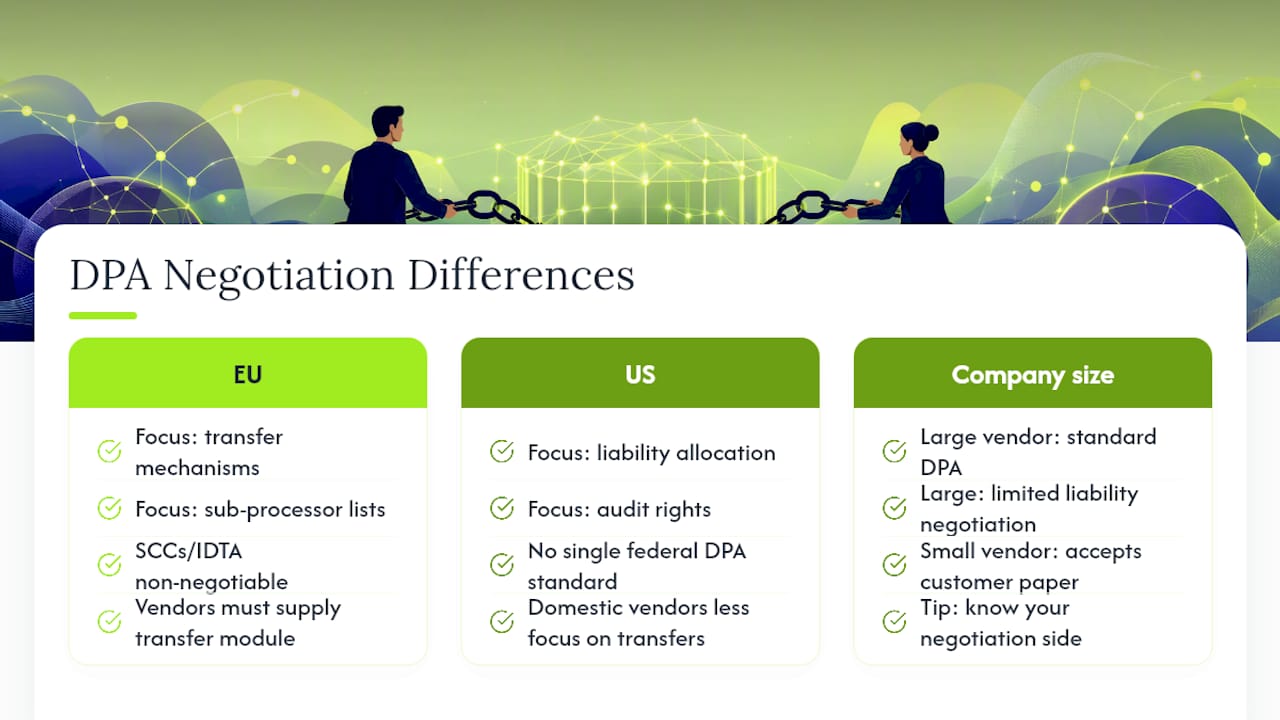
In the EU, negotiations tend to center on transfer mechanisms and sub-processor lists, since SCCs or an IDTA are non-negotiable the moment data crosses into a country without an adequacy decision. Vendors headquartered outside the EU should expect to produce a specific transfer module, and controllers should check that the selected module actually matches their relationship (controller-to-processor versus processor-to-processor) rather than accepting a generic annex.
A separate obligation trips up non-EU and non-UK companies more often than it should. GDPR Article 27, and the equivalent provision under UK GDPR, requires a controller or processor with no establishment in the EU or UK to appoint a local representative once it offers goods or services to, or monitors, data subjects there. That representative becomes the point of contact for supervisory authorities and data subjects alike, and its absence is exactly the kind of gap that surfaces during vendor diligence or a regulator's spot check, not during contract drafting.
"Article 27 is one of the most overlooked obligations we see. Most non-EU and non-UK companies simply don't know it applies to them, and it rarely gets raised until it's already sitting inside a DPA negotiation, by which point the counterparty is asking who the representative is and nobody has an answer." — Oyster Shield
Since the requirement runs on top of, not instead of, the underlying DPA, it's worth confirming during negotiation whether the counterparty actually has this representative in place. Specialist providers like DilicheckRep exist precisely for this gap, letting a company without an EU or UK entity appoint a compliant representative in minutes rather than standing up a physical presence to satisfy the requirement.
In the US, where no single federal DPA standard exists, negotiations often focus more on liability allocation and audit rights than on transfer mechanics, particularly for domestic-only vendors. Healthcare and financial services add another layer entirely: HIPAA business associate agreements and financial services data-sharing rules stack on top of, rather than replace, standard DPA terms, so a healthcare vendor contract typically needs both documents working together.
India is worth tracking as its own case, and increasingly a distinct one from GDPR rather than a copy of it, as the GDPR vs. DPDP comparison above lays out. The short version for negotiation purposes: a DPA built for GDPR or CCPA compliance shouldn't be assumed to satisfy the Digital Personal Data Protection Act (DPDP), 2023 as-is, and companies processing the personal data of Indian residents, or relying on India-based processors, are better off treating that DPA as a starting template to revisit once the DPDP Rules take final effect.
Company size shifts the negotiation too. A large SaaS vendor will usually offer a standard DPA with limited room to negotiate liability caps, while a smaller vendor selling into an enterprise client often has to accept the customer's paper entirely. Knowing which side of that dynamic your organization sits on before negotiations start saves a lot of wasted redlines.
Fast-growing companies feel this dynamic the hardest, since they're often negotiating DPAs with enterprise customers and vendors alike before they've built out a legal team big enough to run either side well. Oyster Shield, an ALSP focused on legal operations for PE- and VC-backed companies, regularly steps into that gap to negotiate this category of contract directly, pushing back on inflated liability caps and vague breach notification language so a scaling company doesn't have to choose between speed and a defensible DPA.
Why Most DPA Programs Fail at Implementation, Not Drafting
The DPA drafting advice out there is mostly fine. Article 28's checklist isn't complicated, and any competent legal team can redline a vendor's security section or push back on a liability cap. The advice that's missing is what happens after signature, and that's where most compliance programs actually break.
A signed DPA that nobody tracks is functionally the same as no DPA at all the moment a regulator or acquirer asks for proof. I've seen the same failure pattern across a lot of vendor programs: the MSA execution goes smoothly, everyone assumes the attached DPA activated with it, and six months later nobody can produce evidence that the sub-processor notice requirement was ever followed. The contract language was fine. The operational layer never existed.
If you take one thing from this article, prioritize the tracking infrastructure before you perfect the clause language. A slightly generic breach notification clause paired with a system that actually flags when a sub-processor changes beats a beautifully negotiated DPA that sits in a folder nobody opens. Tools built for SaaS due diligence readiness exist for exactly this gap, and the broader legal-ops platform space is worth exploring before your next audit forces the question.
— Matias
This article is general information, not a substitute for advice from a qualified lawyer. Consult a qualified legal professional about your own circumstances before acting on anything here.
Sources
FAQ
What Does a Data Processing Agreement Do?
A DPA legally binds a processor to specific rules for handling personal data on a controller's behalf, covering security measures, breach notification, sub-processor use, and deletion at the end of the relationship.
What Are the Six Legal Bases for Processing Data Under GDPR?
GDPR lists consent, contractual necessity, legal obligation, vital interests, public task, and legitimate interests as the six lawful bases; a DPA doesn't create the legal basis itself but documents how the processor supports whichever basis the controller relies on.
Is a DPA Required in the United States?
No single federal law mandates a DPA in the US, but state privacy laws like the CCPA and CPRA require specific contract language for a vendor to qualify as a "service provider," which makes a DPA-equivalent contract standard practice.
Are Data Processing Agreements Mandatory?
Yes, under GDPR Article 28, a written DPA is mandatory any time a controller engages a processor to handle personal data, with no exception for company size or data volume.
How Is a DPA Different from an NDA?
An NDA protects confidential business information generally, while a DPA specifically governs how personal data gets processed, secured, and deleted, and it carries mandatory content requirements under Article 28 that an NDA never addresses.
Recommended
Ready to automate your due diligence?
Get a free healthcheck of your company's audit readiness. No credit card required.
Related articles
Cut Cycle Time in Legal Ops: 5 Pilot Contract Management Best Practices
The highest-impact contract management best practices come down to five moves: centralize every agreement in one searchable repository, standardize templates and clause libraries, assign clear RACI ownership, automate intake and approval routing, and track KPIs like cycle time and renewal accuracy. This guide breaks the work into a prioritized list, a phased rollout, and the metrics that prove it's working.
Roll Out Private Equity Legal Operations and Cut DDQ Time
Legal operations creates value across the whole private equity ownership lifecycle — acquisition, first 100 days, hold period, bolt-ons and exit — not just at the diligence stage. This guide covers continuous legal readiness, the people-process-technology-accountability framework, portfolio legal health baselines with permissioned reporting, contract intelligence beyond renewal dates, and legal resource management beyond invoice review.
AI Contract Review: Audit Ready Results and a Buyer's Checklist
A buyer's guide to AI contract review: how the technology actually works, the features that matter, a vendor evaluation checklist, common red flags, and where Dilicheck fits.